- Issue #21
- Kite Marsh :: “Early Spring Crush”
No action is erased from the earth
but most are written over, covered in the old
bodies of our sweethearts, flooded
when the ice melts, grown again in
a carpet of winter aconite, alive this
warm February day
with hundreds I mean hundreds of bees.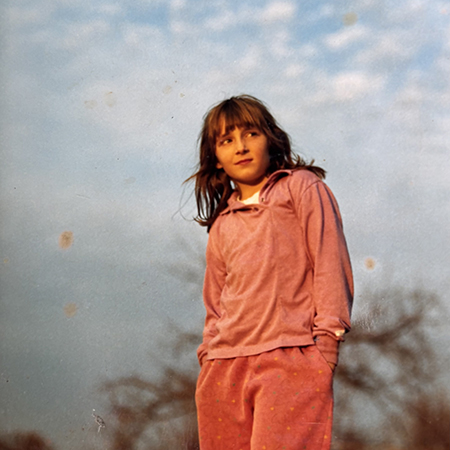
Kite Caroline Marsh is a writer and artist interested in nutrient cycling and migrations. Her writing has appeared or is forthcoming in Taco Bell Quarterly, Plott Hound, Source Magazine: Thinking About Photography, and McSweeney’s Internet Tendency.
- Mary Beth Becker :: “PRAYER OF SAINT FRANCES”
Lord make me a channel
of wonderings. Make me
a yellow magnolia, crown
like an O’Keeffe flower,
fold and shadow, gingerpeel.
Save me the tumble of
guilt-making and ruminate.
Give me blossom. Can the word
miracle weaken from overuse
like love? Are repetition
and erosion kin? Keep me obsessed
with this woman, Lord,
increase my bewilderment.
I do not ask to be understood
but understand, to sit at the
feet of my lover and know
they connect to her ankles,
her spotted calves, let me look
with certainty, marvelous at the fact
of her knees, and when she steps
show me the white clover springing
from her absence in the grass.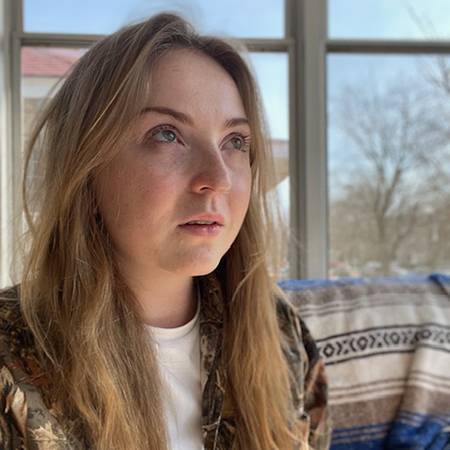
Mary Beth Becker is a lesbian poet living in Minneapolis, Minnesota. A 2025-2026 Loft Mentor Series fellow in poetry, her work has been published in Hobart, Gulf Stream, South Florida Poetry Journal and West Trade Review, among others. She co-founded Minnesota’s first online support group for victim-survivors of domestic violence. She is a two-time Pushcart Prize nominee, a Best-of-the-Net nominee and has received support from the Juniper Summer Writing Institute and Sundress Academy of the Arts. She was raised in the woods north of Omaha, Nebraska.
- Cassandra Urquhart :: “Impossible Goldenrod”
When I was young I saw the impossible:
A bumble bee that seemed to float just
in front of a cluster of mustard yellow
flowers; wings unmoving, oddly positioned
the wrong direction for feeding, as if
fleeing and then stuck. But when I was young
I did not see the impossible, I moved closer
to see a little mellow, also yellow ambush bug
holding their floating meal with a strong
proboscis and the bee never knew what hit her.Now, I always watch the goldenrod. I watch
crab spiders and ambush bugs wait
for the bees and mosquitoes to pollinate
the plants and hope to catch their daily breads.
I always watch for green lynx spiders and
soldier beetles and the swelling of a
welcoming new gall or a cluster of aphids. I
watch for the miracles to explain themselves
with the complexities of allometry and survival
and it never fails to make me smile.I was never a plant girl. It was always the insects
and arachnids that fascinated and moved me. I owe them
for seeing me through some of the worst times in my life.
They’ve been protection from bullies because
someone needs to get the wasp out of the classroom,
right? They’ve been my right to continuing an
education in the form of a lifetime obsession with
the beauty and accidental cruelty of mosquitoes.
They were my friendship with my favorite cousin
and a source of comfort when he left us much too young.When I was young, I saw the impossible
in the shape of a strong little bug hiding
in these chaotic yellow clusters and feeding
on a bee that tried to feed on the flowers. This
little bug, holding a meal twice its size with
only its mouth, squeaked softly when it noticed
me and became my favorite insect for several years.
I’m much older than I was and I still smile every time
I see goldenrod, but it took me two decades to fully understand
that, for all my love of arthropods, I should also thank the plant.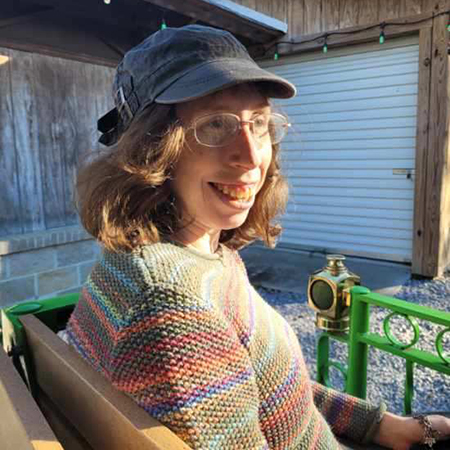
Cassie Urquhart (she/her) is a happy grumpy lesbian who lives in a tiny apartment with her dog, her wife, and one too many cats. She’s an entomologist and poet who also edits and works with rescue animals, part-time. Although she’s been writing for most of her life, she only began submitting poems after completing a science communication workshop through the Hubbard Brook Foundation. After having three poems successfully accepted for publication through that program, she has continued to write and submit work regularly. Her poems are largely themed around nature, loss, and occasional life moments. You can find her poems online and in print at Exist Otherwise, Silkworm, and other publications.
- Tyler Lemley :: “Sins”
The meadow pulses,
breeze breathe
bee stings.
You suck in through your nose
knowing
no matter who’s killing
dying
the headlines can’t reach you
here with the bluebonnets.Away from stop signs
cement
you convince yourself
beer-breathed hunters don’t perch
in the tree line,
littering the Earth
bullet molts.
Take only pictures, leave only
shotgun shells
forest green Dos Equis shards.It’s hard to grapple with the sins of your people,
so bathe in the blue
while you can
before the trucks come
to pour black sludge
over lavender peddles
and spray on the yellow lines
the highway.
Tyler Lemley (they/them) is a queer, Texan poet with a degree in Theatre Arts and English from the University of the Incarnate Word in San Antonio, Tx. They have been published in Fourteen Hills, The Tusculum Review, Black Fox Literary, and elsewhere. They were a finalist for the Pinch Literary Award.
- Sumitra Singam :: “My Father Surveys My Garden as He Helps Me Pack After the Divorce”
There is a row of perfectly viable yet uprooted alocasias at his feet.
Eighteen years ago, the red brocade sari weighing me down, Appa had asked if I was sure. “He doesn’t seem very vital.”
The Elephant’s Ears had been like velvet against my legs.
“I loved those plants,” I said.
“Well, they weren’t edible yams,” he says.Appa has removed them by the corms. They look like severed trunks.
“Anyway, it is done now.”What he means is there are plants that serve no purpose but their own. He means there is no room in my garden for such luxuries. He means, put them on the sidewalk for someone who can afford that.
Sumitra Singam is a queer, neurodiverse Malaysian-Indian-Australian coconut who writes in Naarm/Melbourne. Her work has been published widely, nominated for a number of Best Of anthologies, and was selected for BSF 2025. She works as a psychiatrist and trauma therapist and runs workshops on how to write trauma safely, and the Yeah Nah reading series. She’ll be the one in the kitchen making chai (where’s your cardamom?). You can find her and her other publication credits on Bluesky: @pleomorphic2 & sumitrasingam.squarespace.com.
- Jax NTP :: “i am as stubborn as the milk-blue patience of oyster mushrooms pushing through damp leaf-rot overnight” and “what if guilt is a greenhouse”
i am as stubborn as the milk-blue patience of oyster mushrooms pushing through damp leaf-rot overnight
1. i am rooted but i flow* =
cải chua sweating salt in a cloudy jar, fish sauce drying sweet-metallic on the wrist, garlic bruised under the knife, mustard greens sinking into sour water the way grief learns preservation. a witchy professor forest relic, dark emerald spellbook energy, tiny literary dragon hoarding gross-tender little lunar cyst poems and student drafts. people with privilege get to leave when things harden around them; i am left looking resentful because responsibility grows roots through ankles: passports bloom where some bodies blister. i stand ankle-deep in caregiving, tendon threaded to hospital light, rice steaming for a mother who forgets her knees. Tiger Balm ghosting the wrist, knees clicking against pearl-slick kitchen tile. A is not B but the emotional shape feels familiar: your leaving wears my father’s silhouette badly, sleeves too loose, still the body flinches, not the same knife, only the old shine of metal in another doorway.
2. i am rotted but i ferment =
you chose yourself when i wanted us. mango lassi salt-sweet at the lip, your voice still warm on the phone. and still i ask if i would have left too had safety opened its hand to me. but i stayed. ở lại – until the mouth turns chua. rage + grief + envy + betrayal braided like daikon sweats sugar-cloud into vinegar, jar breathing sulfur, lid buckling softly in the cupboard, sour blooms under the tongue. we learned to scan for who leaves before they leave, embarrassment is grief wearing another face to survive this bone-soft room. performative reassurance arrives after hurt is already curdled, vinegar too late to stop the souring.
3. i am rotted but i flower =
choosing yourself is not automatically abandonment, but when abandonment raised you, the body confuses fungal bloom for prophecy. i guard unfinished essays like wet hatchlings, red pen teeth, cardigan smelling faintly of rain and old paper, green chrome nails flashing as student drafts molt warm in my lap, small dragon nesting in annotation margins, small permissions – còn lại – what remains alive. hope is embarrassing only in hindsight; i know this now, wiping my face in a campus bathroom stall. i am as stubborn as the milk-blue patience of oyster mushrooms pushing through damp leaf-rot overnight, soft as skin after swelling. but some swellings burst and do not punish the skin for surviving pressure. pus-light under the skin giving up its small moon.
*Virginia Woolf
what if guilt is a greenhouse
i want to write a report on guilt but the form keeps sprouting
into something softer like a houseplant that refuses its assigned corner
i say guilt and it opens a drawer i did not install
inside is my mother asking when i am coming home
and i begin softlocking answers that sound
like insects trapped inside a swollen peach
i am delayed by fog i am delayed by a version of myself
that does not return on schedulethe data is unreliable because i keep growing it
i graft her imagined disappointment onto neutral sentences
i water a tone that may not exist
when she says okay i hear a small collapse
i cultivate it i trellis it up the wall until it looks architecturalwhen my uncles talks about his children
he wants to release them like a well trained bird
he wants distance to photosynthesize into a life
i try to believe in that climate
i try to root in a place where leaving is not a moral event
but my body composts every departure into something dense
and useful for future self accusationeven now gender behaves like volunteer mint
appearing where nobody planted it
crossing boundaries i did not authorize
refusing the labels pressed into nursery stakesi am almost forty and still inventorying permission
i prune my days into shapes that resemble obedience
even my freedom has a caretaker voice narrating it
be careful be grateful be nearwhat if the guilt is a greenhouse
i constructed from guesses
what if she is not inside it at all
what if i am tending an empty conservatory
where ghost orchids bloom without witnesses
and pitcher plants keep mistaking flies for answers
polishing salt-bloomed lens until i can see myself
clearly enough to apologizethis report proposes that guilt behaves like a familiar animal
it follows it waits it learns the sound of your keys
it does not require religion only repetition
only a soft chair where it can sit and watch you choosethe only other thing is nothing
which i keep misplacinghave you seen my booger
it was small and precise and briefly mine
i examined it like evidence then lost it to the air
this is how i handle most artifacts of the body
i locate them i assign meaning i misfilei am trying to live a life that does not overinterpret its own mildew
i am trying to leave without narrating the leaving
i am trying to let her voice arrive as itself without cultivating extra rooms for itthe monstera keeps splitting itself into newer versions
without asking whether division is damagefor now i keep the greenhouse
for now i sit inside and note the moss learning the shape of abandonment
for now i watch philodendrons climb toward light
without asking whether they deserve it
for now i practice opening the door and not calling it betrayal
Jax NTP teaches critical thinking, literature, and poetry at colleges across California. They serve as Poetry Editor for The Ear (IVC) and Indicia Lit. Their words appear in Apogee Journal, Berkeley Poetry Review, Breakwater Review, Santa Clara Review, Lunch Ticket, and elsewhere. They are the author of In Bones & Tentacles: How to Pivot When You’re Paralyzed (Moon Tide Press, 2026). Read more: jaxntp.com. IG: @jaxntp @jax.ntp.poet.
- Shon Mapp :: “Mother Unmothered”
By your hands, speckled forests
emerge, miniscule. Pinhead moles,disturb corrupt substrates, compact
& discerning. Until my disruption-a pre-cleaved zygote. A taproot
that should’ve been pluckedfrom earth & left you, a life-
happy, unwed, wandering. Satedin solitary work of weeding
perennial abuse, alongside lacewings& beetles. Baptized in spent soil.
Tumbling the rooted rotten. Youshould’ve been a farmer. Seeded.
Bloomed. Born real fruits.
Shon Mapp is a Bajan writer whose pieces explore immigrant identities, kinship, and lesbian intimacy. Her words have been published in Stanchion, HAD, Fourteen Poems, and Neologism, among other journals.
- Chloe Lim :: “IN WHICH I MAINTAIN MY OPINION ABOUT DUALITY”
Willows look blue under spring highs. The whole of me bubbling through bark, half episode and half poem. You wrote my name five times. The sun slashed past catkins. The time turned three-weeks-since-we-last-heard-the-word-dyke. We sat on the steaming gravel, swiping through hibiscus hanbok. Act on what’s civil, say I do not. Let me learn. I watched your lips as your ribs grew restless. They tasted of pepper and Zero Cola. You pressed your wrist into mine & counted. We’re both gonna die, you said, or I think that’s what you said. I said I think, then I said magnolia, and then I said nevermind. You understood before I could forget. Teach me to stay. Teach me, before summer learns our names.
Chloe Lim is a poet and writer. Her work has been previously published in independent magazines, and she plans to study literature at university. When she is not writing, she spends her time learning new languages, listening to music.
- Lawrence Schimel :: “Paradise Lost”
The bar was packed, but the press of bodies
was welcome, unlike the cramped apartment
I shared with four others to be able to affordthe rent, which was why I’d texted a friend
and begged him to meet me here for a drink
and mutual commiseration over our roommatesand about a hookup I had over the weekend.
“It sounds idyllic,” he remarked, after I told him
about visiting the spacious apartmentof a guy I called Plant Daddy in my retelling
of our encounter, because he was not just
a hot top, but his entire place was lush withgreenery–spider plants spilling like a canopy
over the bed, hydroponic shelves of fragrant
herbs like a library of tastes in the kitchen,so many pots of standing plants (many taller
than me!) creating a labyrinth of rooms—
and I couldn’t tell which aspect I foundmore attractive. “Sounds like it was a hothouse,
in all meanings of hot. So why are you
sad?” Before I could answer, a twink behind meinterrupted. “I couldn’t help overhearing…
This the guy on 15th street?” Turned out
that he, too, had once been granted a visitto Eden. He warned me, “He doesn’t ever do
repeats.” We shared a look, this stranger and I,
seeing not one another but the steamy sex we’deach had with that same man in his urban garden.
For a moment I thought—hoped—I might be
different, then realized that he, too, had alsopreviously felt that same unfulfilled desire.
“That’s why I’m sad,” I answered my friend.
“Because he made us dream of goingback.”

Lawrence Schimel is a multilingual author and literary translator based in Madrid, Spain. He has translated into Spanish books such as Maggie Nelson’s Bluets, Danez Smith’s Don’t Call Us Dead, and George Takei’s They Called Us The Enemy, and into English Ángelo Néstore’s Impure Acts (a finalist for the Thom Gunn Award), Luis Panini’s Destruction of the Lover, and Johanny Vázquez Paz’s I Offer My Heart as a Target (winner of the Paz Prize from the National Poetry Series). Photo by Nieves Guerra-Blue.
- Chella Courington :: “Phalaenopsis”
Jenny doesn’t remember when she quit listening to Ana, smiling now and then as Ana recalls another of her nude dreams. In her flannel PJs she leans against the cupboard door, never dropping a syllable. Like a bird’s nest, her grayish-blonde hair is sprigged when she wakes. Last Christmas Jenny gave her a satin pillowcase, but Ana rarely uses it.
“Did you listen to what I just told you?” she asks.
Jenny smiles. “Definitely,” and she hands her two glasses of filtered water. “Would you put these on the table?” The sun cuts through the kitchen window, warming Jenny’s pale shoulders beneath the red and black plaid bathrobe. After five years, she has learned how to appear engaged when Ana goes on about her dreams. Every morning a new narrative that must be spoken before anything else.
Jenny hears the rise and fall of Ana’s voice. The changes in volume, the shift in tone. The way she lisps where an s and z sound like th in thunder, her tongue catching between her teeth. Cute, even sexy, when they first met at a yard sale. Ana chattered about Sienna Dinnerware on the lawn—salad plates and saucers fringed in green, camouflaged by blades of crabgrass. But now? Her words are mostly white noise.
Jenny takes her cereal to the table while Ana spreads peanut butter on an English muffin. They sit across from each other, a pink moth orchid in the center.
“She looks sad,” Jenny says, reaching out to the lowest bloom, rubbing a petal between her right index finger and thumb. Gently to avoid damage.
“It’s just a flower,” Ana says.
Jenny remembers how her mother tossed a plant as soon as the bloom was off. When she was thirteen, her mother sent her to Miss Howard’s School for Girls in Waycross, Georgia.
“She’s been with us as long as we’ve been together,” Jenny says, poking her finger in the soil to see if she were dry and pouring just enough water into the clay pot to humidify the roots.
“So has the couch,” Ana says, wiping peanut butter from her lips.
“I never liked that couch,” Jenny says.
“I’ve never been good with flowers,” Ana says
Sliding her hand around the sides of the cool pot, Jenny knows the orchid and how easily she can be traumatized if left untended. Mealy bugs spread their cottony mass over her buds and stems and suck her sap, leaving a sticky path in the wake. Jenny lifts the plant.
Ana takes their plates to the sink. “Orchids are too much trouble,” she says.
Jenny listens to the retreat of Ana’s footsteps and moves the orchid near the window so morning sun can shine through the blooms, turning them into a spectacle of light.
Blossoms fall to the dusty floor.
Originally published as “The Orchid” in oranges journal.
Chella Courington was born and raised in Southern Appalachia in a storytelling family who taught her how to value the word. Courington’s creative publications include one novel, one novella, several chapbooks of poetry and fiction, and innumerable poems and stories in journals and anthologies. Her work has been nominated for Best of the Net, Best Small Fictions, and Pushcart as well as awarded individual prizes. With teaching as her livelihood, she moved from Montgomery, Alabama, to Santa Barbara, California, twenty years ago, giving her the space and distance to understand her past.